Feature
How Copenhagen Port is cutting cruise emissions with Europe’s largest onshore power facility
The new €33m facility at Copenhagen Malmö Port will supply shore power to 300 cruise ships annually, reducing CO2 emissions by 17,000 tonnes, marking a key step towards meeting EU maritime decarbonisation targets. Frances Marcellin investigates.
The new power supply in operation. Credit: Copenhagen Malmö Port
Copenhagen Malmö Port’s (CMP) new onshore power supply (OPS) facility is the largest in Europe. Recently inaugurated, it’s pitched to save 17,000 tonnes of CO2 equivalent each year by providing electricity to 300 cruise ships across the three piers at Oceankaj and the two piers at Langelinie terminals. It will also support ferries docking at Søndre Frihavn.
Costing around €33m ($38.32m), the EU’s Connecting Europe Facility (CEF) for Transport financed 20% – €6.6m ($7.66m) – as part of its Baltics Seaports project across Denmark, Finland, and Sweden in the Scandinavian-Mediterranean corridor.
Initially created in collaboration with engineering consultancy COWI, Danish developer Udviklingsselskabet By & Havn took over the project in 2021. Following the EU tender, Danish electrical equipment supplier PowerCon was awarded the contract in 2023, and construction started in 2024.
Cruising towards shore power goals
AIDA Cruise’s AIDAnova was the first cruise ship to cold iron at CMP, making it the 14th cruise port in Europe where AIDA ships access shore power. In 2024 AIDA Cruises used shore power during 360 port calls, a fivefold increase on 2023.
“The inauguration of the shore power plant in Copenhagen is an important step towards the further implementation of the maritime energy transition in Northern Europe,” says Felix Eichhorn, President of AIDA Cruises. "By investing in the use of this advanced technology, we are actively supporting the European Union's goals of building a shore-side power infrastructure in all major EU ports by 2030.”
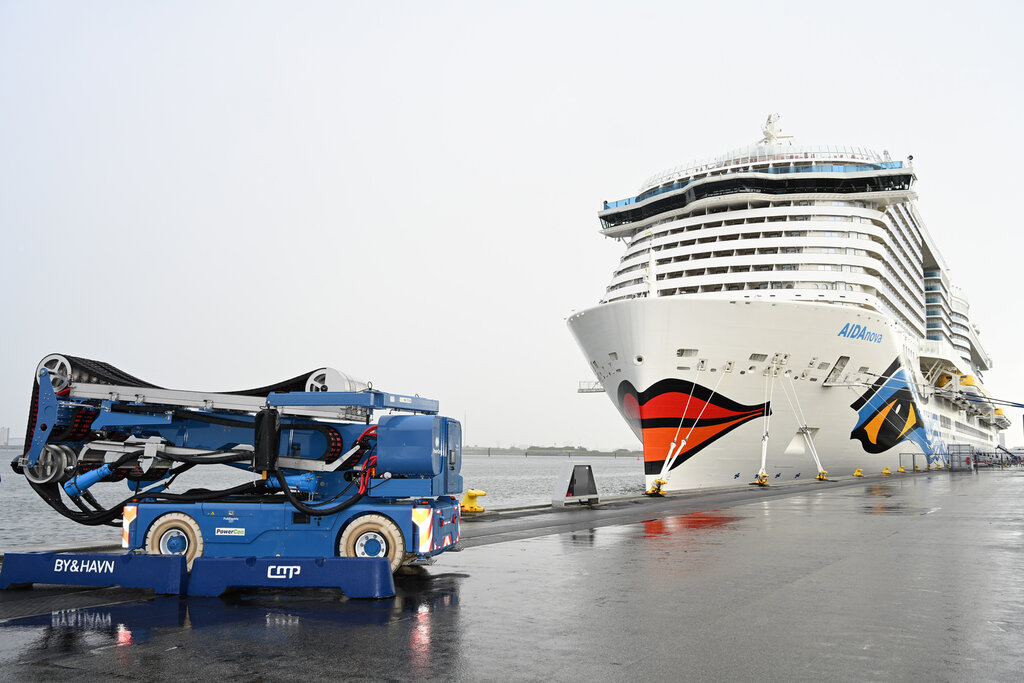
Credit: Copenhagen Malmö Port
Shore power is a major tool for decarbonising maritime transport in the EU under the FuelEU Maritime Regulation and the Alternative Fuels Infrastructure Regulation (AFIR).
By 2030, 90% of port calls by container and passenger ships over 5,000 GT at trans-European transport network (TEN-T) core ports must be served by shore-side electricity with greenhouse gas intensity decreasing by 2% by 2025, 6% by 2030, and up to 80% by 2050.
According to the European Environmental Agency, 35% of EU-27 TEN-T core ports are equipped with shore-side electricity, making 407 berths. However, the ESPO Environmental Report 2024 – which drew data from 83 European ports across 21 countries from members of the EcoPorts Network – noted that 58% of surveyed ports provided onshore power at one or more berths. Among them, 83% provide low voltage facilities, while 56% provide the high voltage that caters to commercial ships.
Shore power increases cruise call support
In 2018, global shipping emissions represented 1,076 million tonnes of CO2, 2.9% of global emissions caused by human activities. If industry growth continues along the same trajectory, emissions could increase by up to 130% of 2008 emissions by 2050, undermining the goals outlined in the Paris Agreement.
In 2025 CMP is aiming to reach net-zero emissions and from 2020-2024 it lowered CO2 emissions from its own operations (Scope 1 and 2) by 76%. Copenhagen hosts expedition and major cruise lines from around 40 companies, including MSC Cruises, Royal Caribbean, AIDA, Princess, Silversea, Ponant, and Mystic. While CMP supports around 300 calls a year, this is less than the average of 350-375 calls a year pre-Covid-19 and pre-Ukraine war. However, these numbers are set to rise.
“In the cruise industry it’s hard to predict anything further than 3-5 years as deployment can easily shift given many external factors such as geopolitical, economic, wars, etc, but we foresee a possible slight increase for the years to come,” explains Luis de Carvalho, CMP’s commercial cruise director.
“What we see currently is that the season is being extended, to include also the period of October to April, contributing to the spreading tourism all year around,” he continues, adding that the shore power is also improving the acceptance of cruise calls to the city.
“In addition, we see an increased number of overnights, allowing passengers to stay longer in the destination, spend more money and enjoy the best of what the city has to offer.”
Wider view and obstacles
Increasing OPS is crucial for industry sustainability as ports increasingly suffer disruption from climate change. And as around 90% of European ports are situated in urban regions – with many passenger terminals in city centres – the community’s health and environment are increasingly impacted too.
According to the European Sea Ports Organisation, more ports are increasingly disrupted by climate change – 64% up from 47% last year – with 73% of ports improving infrastructure and 86% integrating climate adaptation into their practices.
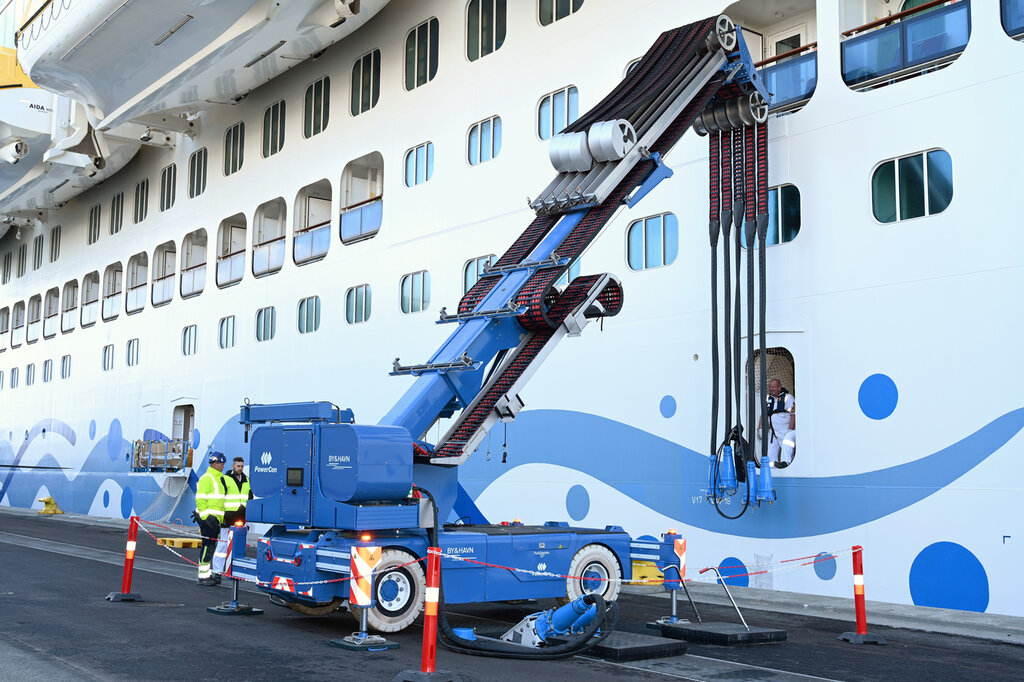
The new power supply was built by PowerCon. Credit: Copenhagen Malmö Port
Insufficient grid infrastructure and inadequate grid capacity are primary obstacles to implementation with 45% and 40% of ports, respectively, struggling with these problems. Flooding and extreme rainfall, rising sea levels and storm surges and high winds are among the biggest problems, as is rising heat and its impact on infrastructure and systems.
Somehow these problems will need to be overcome, especially in some of the most popular destinations, as noted in a eport by Sustainable Ships, which highlights a gap in the energy required and the shore power supplied.
It explains that in 2019, ships with over 400 gross tonnage spending more than two hours at berth in the 489 major EU ports demanded a total of 5,886 GWh. Highlighting that 70% of this demand came from the TEN-T network ports, which provided 4,093 GWh it estimates that the EU needs to triple or quadruple its installed shore power by 2030 to meet FuelEU and AFIR regulations.
Advancing sustainable port operations in Europe
In terms of geographical focus, France, Spain, and Italy accounted for over half of the total, driven by the popularity of Mediterranean and Western European routes, making them priority investment locations.
According to ICCT, emissions could be cut by up to 69% if all onboard energy demand is electrified. They exemplify boilers, stating that these should also be retrofitted, electrified or connected to shore power facilities, just like auxiliary engines, since they are responsible for 44% of all at-berth CO2 emissions. It also states that all EU ports – not just TEN-T ports – should be included in the regulations.
Copenhagen’s new onshore power facility signals a major leap forward for sustainable port operations in Europe. By enabling cruise ships and ferries to plug into clean electricity, CMP is not only reducing greenhouse gas emissions but also strengthening the port’s role in the EU’s maritime energy transition.
While challenges remain – particularly in grid capacity and infrastructure – this investment makes Copenhagen a frontrunner in green port technology within Europe’s cruise sector.
